

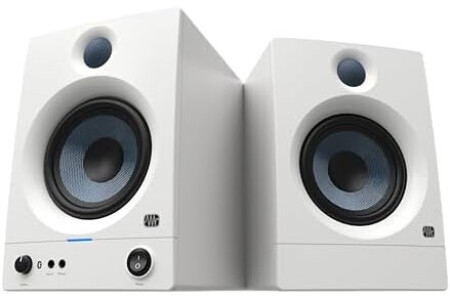
- HONEST. Eris 5BT near field studio monitors deliver studio-quality, accurate sound perfect for music production, hi-fi audio listening, or multimedia reference. - EXPRESSIVE. Clear, accurate audio with a big low end — Eris 5BT's woven-composite woofers’ weave and nature result in tight bass that you can feel, as well as cleaner overall sound. - POWERFUL. Compact speakers that pack a punch — 100 Watts of Class AB dual amplification (50W per side) provide all the volume and loudness you want without sacrificing tonal balance or audio clarity. - BLUETOOTH 5.0 WIRELESS CONNECTIVITY. Ultra-reliable Bluetooth 5.0 delivers seamless integration with your other devices while flexible wired connection options ensure easy compatibility with virtually any monitoring setup – so you can plug in, pair up, and get to work without missing a beat. - ULTRA-WIDE LISTENING SWEET SPOT. The natural high-frequency response of the 1-inch ultra low-mass, silk-dome transducers (tweeters) provide superior stereo imaging from nearly any listening angle. - ALL THE CONNECTIONS YOU NEED. ¼-inch TRS balanced inputs on the back panel for professional audio devices, unbalanced RCA inputs for consumer electronics, plus a convenient front-panel ⅛-inch TRS stereo aux input for your phone. - PRECISION-TUNE TO YOUR ROOM. High- and low-frequency tuning controls allow you to customize your audio output for your ears, room size, and speaker orientation. Whether on a desk, bookshelf, or next to a turntable or record player, Eris 5BT's produce clear, room-filling sound. - QUICK-SWITCH TO HEADPHONES. The easy-access front panel headphone output and built-in headphone amplifier allow for plug-and-play headphone media reference when needed. - ADD MORE LOW END. The 50W, 8-inch companion Eris Sub 8BT studio subwoofer delivers a massive low-frequency boost and Bluetooth connectivity to your Eris 5BT’s, creating a powerful 2.1 speaker system. - POWER SAVER MODE. Power-saving mode auto engages after 40 minutes of idle time.
Color: White
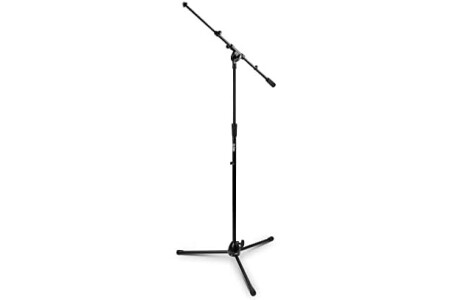
- Sturdy. Heavy-duty steel and zinc construction with extra-thick tubing and premium threading for dependable performance. Nonslip rubber feet stop skids to ensure the stand stays safely in place. - Versatile. 19″–30″ telescoping boom with metal shafts, clutch, threaded stems, and counterweight for precise mic placement with outstanding stability and balance. - Adjustable. Ergonomic clutch grip and nonrotating lower shaft for ease of height adjustment. The main stand height adjusts 36″–64″ for miking vocals and a wide range of instruments as well as for overhead use. - Dependable. Bolts in the leg housing tighten and loosen the leg joints, enabling the user to maintain the tension over many years of use as well as increase and decrease the tension based on personal preference. - Portable. Tripod base quickly folds down flat for ease of load in, setup, teardown, and load out while also enabling compact storage and efficient transportation.

Are you ready to discover an entirely new way to record your filmmaking director notes? This Director's Storyboard Notebook provides the perfect solution to note, track, and record every scene. Measuring 8.5 x 11 inches the Director's Storyboard Notebook is conveniently sized and simple enough for anyone to use. Features included in this Director's Storyboard Notebook : * Storyboard Direction Pages: Co-Director, Script Page, and Scene Number * Location, Date, Scene Characters/Actors, 9x Storyboard Panels Per Page: * Scene, Shot / Frame, Shot Type, Clip Length, and Panel Notes Section * Shot Details Page: Shot No., Scene Time, Internal/External, * Frame Size, Angle, Lens, and Action Description * Dedicated sections for further detailed notation Click 'Read Sample' to see inside, and press 'Add to Basket' to get your copy of the Director's Storyboard Notebook today.


- Las cuerdas Slinky de Ernie Ball son las elegidas por leyendas de la música de todo el mundo como Slash, Jimmy Page, Metallica, Eric Clapton y muchos más. - El calibre11-54 de las Beefy Slinky es óptimo para desafinar. - En paquete Element Shield que garantiza que tus cuerdas estarán igual de nuevas que cuando se fabricaron. - Tono alegre y equilibrado. - Fabricación en California (EE. UU.) con los materiales más recientes y de la mejor calidad.
Color: Beefy (11-54) Nombre de estilo: 1 paquete

- Incluye 3 juegos envueltos de forma individual - Las cuerdas Slinky de Ernie Ball son las elegidas por leyendas de la música de todo el mundo como Slash, Jimmy Page, Metallica, Eric Clapton y muchos más - Las preferidas de guitarristas de muchos géneros, el calibre 10-46 de las Regular Slinky se ha convertido en el referente del mundillo - En paquete Element Shield que garantiza que tus cuerdas estarán igual deque cuando se fabricaron - Tono alegre y equilibrado
Color: Regular (10-46) Nombre de estilo: 3 paquetes

- Las cuerdas Slinky de Ernie Ball son las elegidas por leyendas de la música de todo el mundo como Slash, Jimmy Page, Metallica, Eric Clapton y muchos más. - Las Mammoth Slinky son ideales para afinaciones ultrabajas, incluyendo La caído, Si caído y Do estándar. - En paquete Element Shield que garantiza que tus cuerdas estarán igual de nuevas que cuando se fabricaron. - Tono alegre y equilibrado. - Fabricación en California (EE. UU.) con los materiales más recientes y de la mejor calidad.
Color: Mammoth (12-62) Nombre de estilo: 1 paquete

- Las cuerdas Slinky de Ernie Ball son las elegidas por leyendas de la música de todo el mundo como Slash, Jimmy Page, Metallica, Eric Clapton y muchos más - El calibre 8,5-40 de las Mighty Slinky se sitúa entre nuestros famosísimos juegos Super Slinky y Extra Slinky para ofrecer una tensión ligera y rápida en todas las 6 cuerdas - En paquete Element Shield que garantiza que tus cuerdas estarán igual deque cuando se fabricaron - Tono alegre y equilibrado - Fabricación en California (EE; uU.) con los materiales más recientes y de la óptima calidad
Color: Mighty (8.5-40) Nombre de estilo: 1 paquete

- Las cuerdas Slinky de Ernie Ball son las elegidas por leyendas de la música de todo el mundo como Slash, Jimmy Page, Metallica, Eric Clapton y muchos más. - Las Mondo Slinky de Ernie Ball son ideales para los músicos que prefieran un calibre más grueso con un poco menos de tensión en las cuerdas lisas (Mi, Si, Sol). - En paquete Element Shield que garantiza que tus cuerdas estarán igual de nuevas que cuando se fabricaron. - Tono alegre y equilibrado. - Fabricación en California (EE. UU.) con los materiales más recientes y de la mejor calidad.
Color: Mondo (10.5-52) Nombre de estilo: 1 paquete

- Magnum Slinky es un calibre pesado con una cuerda G enrollada. - Los Ernie Ball Slinkys son interpretados por leyendas de todo el mundo, incluidos Slash, Jimmy Page, Metallica, Eric Clapton y más. - Los materiales y la artesanía de primera calidad garantizan cuerdas de guitarra fiables y duraderas, perfectas tanto para profesionales como para principiantes. - Durante décadas, los Slinkys han proporcionado a los instrumentistas un tono y una consistencia excepcionales en todo el diapasón. - Fabricado en el sur de California
Color: Magnum (12-56) Nombre de estilo: 1 paquete

- Ernie Ball Slinkys son utilizadas por leyendas de todo el mundo como Slash, Jimmy Page, Metallica, Eric Clapton y muchos más - Materiales de primera calidad y una fabricación experta garantizan cuerdas de guitarra fiables y duraderas, perfectas tanto para profesionales como para principiantes - Durante décadas, las Slinky han ofrecido a los guitarristas un tono excepcional y una consistencia uniforme en todo el diapasón. - Similares a las Super Slinky, las Hyper Slinky ofrecen una sensación ligera y rápida con una tensión ligeramente menor en las cuerdas agudas - Alambre de acero niquelado enrollado sobre un núcleo de acero de forma hexagonal estañado.
Color: Hyper (8-42) Nombre de estilo: 1 paquete

This international bestseller, with more than 5 million copies sold, offers a field-tested approach to high-stakes negotiations--whether in the boardroom, in your community, or at home. Life is a series of negotiations, and negotiation is at the heart of collaboration--whether you are a business executive, a salesperson, a parent, a community leader, or a spouse. As a former FBI hostage negotiator, Chris Voss gives you the tools to be effective in any situation: negotiating a business deal, buying (or selling) a car, negotiating a salary, acquiring a home, renegotiating rent, deliberating with your partner, or communicating with your children. Taking the power of persuasion, empathy, active listening, and intuition to the next level, Never Split the Difference gives you the competitive edge in any difficult conversation or challenging situation. This book is a masterclass in influencing others, no matter the circumstances. After a stint policing the rough streets of Kansas City, Chris Voss joined the FBI, where his career as a hostage negotiator brought him face-to-face with a range of criminals, including bank robbers and terrorists. Reaching the pinnacle of his profession, he became the FBI's lead international kidnapping negotiator. Never Split the Difference distills the Voss method, revealing the skills that matter most when it comes to achieving your goals in both your professional and personal life. Step-by-step, Voss show you how to: Establish Rapport Create Trust with Tactical EmpathyGain the Permission to Persuade Shape What Is Fair Calibrate QuestionsTransform Conflict into CollaborationSpot LiarsCreate Breakthroughs by Revealing the Unknown UnknownsNever Split the Difference is your definitive source for defusing potential crises, winning people over, and achieving your goals at work and at home.

Pasado, presente y futuro del dinero: de las piedras al Bitcoin. Una exploración completa y autorizada de Bitcoin y su lugar en la historia monetaria. Cuando en 2008 un programador informático desconocido anunció que había creado un nuevo sistema de dinero electrónico con tecnología peer-to-peer (P2P), pocos prestaron atención. En la actualidad, el Bitcoin es ya una alternativa descentralizada a los bancos centrales y al dinero físico. El patrón Bitcoin analiza el contexto histórico del surgimiento de esta nueva moneda, las propiedades económicas que la han permitido crecer rápidamente y sus implicaciones económicas, políticas y sociales. El profesor y economista Saifedean Ammous explica, con afán pedagógico, la historia del dinero y expone por qué el futuro pertenece al Bitcoin, que, gracias a la tecnología blockchain, ofrece un servicio de pago confiable, seguro y llamado a plantar cara al monopolio de los bancos centrales. Desde las piedras preciosas hasta las monedas de curso corriente, pasando por el patrón oro y las burbujas de expansión crediticia, la historia del dinero es la de crisis y rupturas que buscan ser superadas. Este libro argumenta por qué el Bitcoin puede llegar a ser la solución a este problema histórico. ENGLISH DESCRIPTION Past, present and future of money: from stones to Bitcoin. A comprehensive and authoritative exploration of Bitcoin and its place in monetary history. When a pseudonymous programmer introduced “a new electronic cash system that’s fully peer-to-peer, with no trusted third party” to a small online mailing list in 2008, very few people paid attention. Ten yearsT later, and against all odds, this upstart autonomous decentralized software offers an unstoppable and globally accessible hard money alternative to modern central banks. The Bitcoin Standard analyzes the historical context to the rise of Bitcoin, the economic properties that have allowed it to grow quickly, and its likely economic, political, and social implications. he book moves on to explain the operation of Bitcoin in a functional and intuitive way. Bitcoin is a decentralized, distributed piece of software that converts electricity and processing power into indisputably accurate records, thus allowing its users to utilize the Internet to perform the traditional functions of money without having to rely on, or trust, any authorities or infrastructure in the physical world. Bitcoin is thus best understood as the first successfully implemented form of digital cash and digital hard money. With an automated and perfectly predictable monetary policy, and the ability to perform final settlement of large sums across the world in a matter of minutes, Bitcoin’s real competitive edge might just be as a store of value and network for the final settlement of large payments―a digital form of gold with a built-in settlement infrastructure. Ammous’ firm grasp of the technological possibilities as well as the historical realities of monetary evolution provides for a fascinating exploration of the ramifications of voluntary free market money. As it challenges the most sacred of government monopolies, Bitcoin shifts the pendulum of sovereignty away from governments in favor of individuals, offering us the tantalizing possibility of a world where money is fully extricated from politics and unrestrained by borders. The final chapter of the book explores some of the most common questions surrounding Bitcoin: Is Bitcoin mining a waste of energy? Is Bitcoin for criminals? Who controls Bitcoin, and can they change it if they please? How can Bitcoin be killed? And what to make of all the thousands of Bitcoin knockoffs, and the many supposed applications of Bitcoin’s ‘block chain technology’? The Bitcoin Standard is the essential resource for a clear understanding of the rise of the Internet’s decentralized, apolitical, free-market alternative to national central banks.

There are products from different external stores in your basket, so a wish for each external store will be created.
Note: You will be able to configure each wish individually before publishing it.

 Spanish
(Español)
Spanish
(Español)
 German
(Deutsche)
German
(Deutsche)
 French
(Français)
French
(Français)
 Italian
(Italiano)
Italian
(Italiano)
 Portuguese
(Portugues)
Portuguese
(Portugues)

